
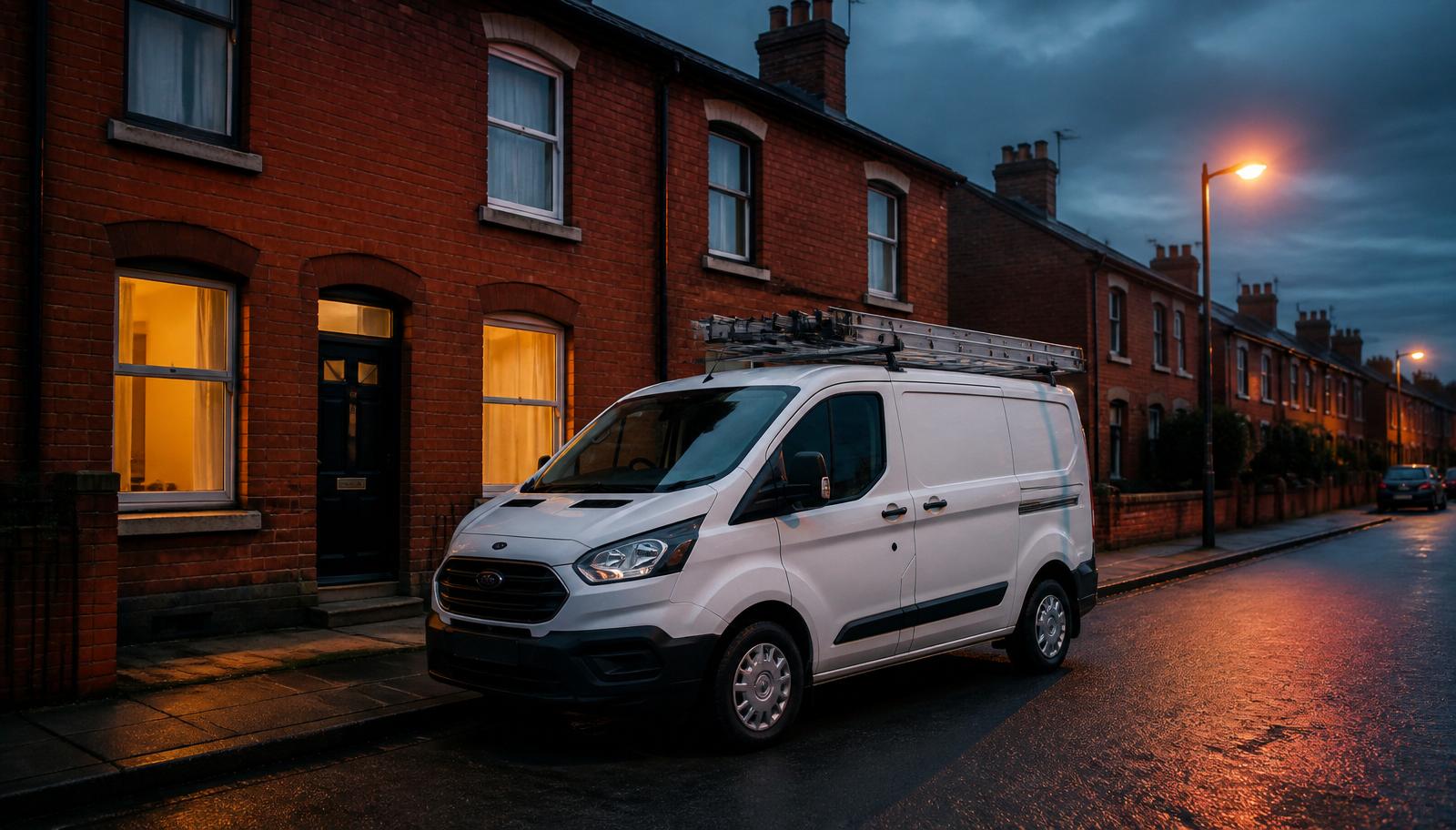
Most contractor accommodation listings shout about the bed and the kitchen. Very few tell you the one thing that decides whether your crew actually books it: where the van goes at night. If you run a mobile trade, hire a Transit, or turn up to site with tools worth more than the vehicle, parking is not a nice-to-have. It is the booking.
At Stays Direct we house project crews across the UK every week, and van parking is the number one filter our team applies before a property is ever offered to a contractor. This guide is the checklist we use internally, written up so you can ask the right questions before you send a deposit, sign a purchase order, or push a crew into a city they have never worked in before.
Why van parking makes or breaks a contractor booking
A hotel car park is monitored, lit, and usually covered by the hotel's insurer for basic liability. A residential street is none of those things. When your lads park a signwritten van full of tools outside a terrace they have never seen, three things happen:
- Insurers get twitchy. Most tools-in-transit and goods-in-transit policies require the van to be on a driveway, in a locked compound, or off-street between stated hours (typically 6pm to 7am). A claim from an unrestricted residential street can be reduced or refused.
- Neighbours get twitchy. Permit zones, resident bays, dropped kerbs, and narrow terraces turn into complaints, penalty charge notices, and awkward WhatsApp messages at 6am from a landlord who has just been called by their tenant next door.
- The crew gets twitchy. Nobody sleeps well when the van with £8,000 of Makita in the back is on a road they cannot see from the bedroom window. Tired crews make expensive mistakes on site the next morning.
Get parking right and the rest of the stay usually looks after itself. Get it wrong and you will be rebooking mid-project, which costs you day-rate downtime, a second deposit, and the goodwill of the property owner you just walked out on.
Key takeaways
- Always confirm parking type in writing before you pay: driveway, allocated bay, permit street, or unrestricted street.
- One space per van, not one space per booking. A four-man crew in two vans needs two spaces.
- Permit zones can add £30 to £120 per week on top of the nightly rate. Ask who pays and who arranges.
- Signwritten vans are refused by some residential landlords. Declare this up front, not on arrival.
- Nearby secure compounds (£8 to £15 per night) are a valid Plan B in city centres and should be identified before the crew travels.
- Height restrictions on covered car parks catch out LWB Sprinters and Lutons more than width does.
- Insurance conditions on tools-in-transit almost always assume off-street overnight storage. Read your schedule.
The seven questions to ask before you book
Every enquiry our booking team sends to a host includes these. Copy them straight into your next email, WhatsApp, or booking form.
1. What is the exact parking arrangement?
You are looking for one of four answers:
- Private driveway (best)
- Allocated off-street bay in a private car park or gated development (good)
- Free unrestricted on-street directly outside (workable, but check street width and turning space for a LWB)
- Permit or pay-and-display zone (workable with a plan and a budget)
"There is usually space on the road" is not an answer. "The last contractor managed fine" is not an answer either. Push for specifics, and get them in a message you can screenshot.
2. How many vehicles can park on site at the same time?
A three-bed house does not automatically mean three parking spaces. Many UK driveways fit one car plus a small hatchback, or one long-wheelbase van and nothing else. If you have two vans and a car, say so, and get a number back in writing. If the property has a shared driveway, ask whether the neighbour is a light sleeper.
3. Will a long-wheelbase or high-top van fit?
Height restrictions catch out more crews than width does. Underground car parks at serviced apartments almost always cap at 2.0m or 2.1m. LWB Sprinters, Lutons, and tipper bodies need explicit confirmation, and so do roof-racked Transits with pipe carriers. If in doubt, send the make, model, and wheelbase to the host and ask for a yes or no.
4. Is the parking secured overnight?
Gated? Lit? CCTV? Overlooked by the property itself so a crew member can see the van from the bedroom window? None of these are dealbreakers on their own, but combined they change your insurance position. If your tools cover requires "secure overnight parking", the definition usually means at least two of: locked compound, monitored CCTV, or off-street behind a locked gate. Send the answers to your broker if you have any doubt at all.
5. Are signwritten or liveried vehicles a problem for the street or the landlord?
Some residential landlords quietly refuse liveried vans because of estate covenants, neighbour agreements, or short-let licensing conditions. New-build estates with management companies are the worst offenders. Better to know on day one than to be asked to move on day three, mid-shift, with a full van.
6. If the road is permit-controlled, who arranges the visitor permits and what does it cost?
In most London boroughs, Bristol, Brighton, Bath, York, Cambridge, Edinburgh central, and swathes of Manchester and Liverpool, you cannot just park. Visitor permits or scratch cards are typically £2 to £8 per day per vehicle. Weekly permits run £30 to £120. Confirm whether the host loads them into the nightly rate, invoices them separately with VAT, or expects the crew to buy them from the council portal on arrival. The last option is the one that goes wrong most often at 8pm on a Sunday.
7. What is the nearest secure compound if the property parking fills up?
Any host who houses contractors regularly will know the answer without hesitating. National operators like NCP, Q-Park, and CitiPark run 24-hour compounds in most UK cities at £8 to £15 per van per night. Independent commercial yards near industrial estates often work out cheaper on a weekly deal, especially if you can commit to four weeks or more. Get the name, the postcode, and the walking time back to the property before the crew leaves depot.
City-by-city: where parking gets hard
Not all UK cities are equal. A rough field guide from our booking pipeline:
- Central London (Zones 1-2): Assume permit-controlled everywhere. Budget £15 to £25 per van per day on top of the room. Prefer stays in Zone 3-4 with driveways and a Tube ride to site.
- Manchester, Birmingham, Leeds, Bristol, Sheffield city cores: Mixed. Suburbs 2 to 4 miles out are almost always free and unrestricted with driveways.
- Cambridge, Oxford, Bath, York, Brighton, Edinburgh Old Town: Permit zones cover most residential streets. Plan on it.
- Hinkley, HS2 Midlands sections, Sizewell, offshore-wind port towns: Free parking, but demand spikes mean driveway properties sell out four to six weeks ahead. Book early or take the compound.
- Scottish Highlands, rural Wales, remote infrastructure sites: Parking is never the issue. Broadband is.
What insurance actually says about your van overnight
Read the schedule on your tools-in-transit or goods-in-transit policy. The specific phrases to look for:
- "Whilst contained in a locked vehicle" — usually means the tools have to be locked inside, and the vehicle itself parked to the policy's overnight storage clause.
- "Overnight storage" — commonly defined as 6pm to 7am, or "when not in use". You must comply for the full window, not just at midnight.
- "Locked building or secure compound" — the strictest version. A residential driveway does not qualify. A locked garage or gated compound does.
- "Off-street parking" — the mid-tier version. A private driveway generally qualifies. An allocated but unmarked bay in a shared car park generally does not.
If your policy says "secure compound only" and your accommodation has a driveway, you are either under-insured or paying for cover you cannot use. Fix that before the crew travels, not after a break-in.
Red flags to walk away from
Some answers should end the conversation:
- "Parking is first come first served on the estate." Translation: you will be circling at 7pm after a 12-hour shift.
- "You can park in the pub car park across the road." Not without written permission from the pub, and not overnight. Landlords change. Managers change. Verbal permission is worthless at 3am.
- "The neighbours don't mind if you use their drive when they are at work." A dispute waiting to happen, usually on day four.
- "There is a loading bay outside." Loading bays are not overnight parking. Penalty charge notices start at £70 and cameras run 24/7 in most cities.
- "It's a quiet cul-de-sac, no one will notice a signwritten van." They will, and one of them will post a photo in a residents' group.
- "The last contractors parked on the pavement." Pavement parking is being rolled out as an offence across the UK, and enforcement varies by council. Not your fight to have.
What good looks like
A properly briefed contractor property will tell you, without being asked:
- Driveway fits two vans up to LWB Sprinter. Additional car can go on the road unrestricted.
- Off-street, unlit, overlooked by the front bedrooms. No permit needed, no time restrictions.
- Signwritten vans welcome. Neighbours are used to trades on the street.
- Backup: NCP Trinity Square is 4 minutes away at £11 per night per van. Direct debit account available if you need it billed monthly.
That is a four-line paragraph, and it sells the property harder than any photo of the sofa or the coffee machine.
Frequently asked questions
Do we invoice parking or bake it into the nightly rate? Whichever the client prefers. Most project managers want it inside a single line item so the PO doesn't need amending. We can also split it out with the compound named and VAT itemised.
Can crews leave vans on the driveway during the day when they're at site? Yes on driveways. Yes on unrestricted streets. Not on permit streets during permit hours unless a permit is in the windscreen. Check the sign, not the neighbours.
What if the crew turns up with more vans than we agreed? Tell us in advance and we will re-check the property or add compound parking. Turning up with an extra van and hoping is how bookings get cancelled by the host on day two.
Do you house crews with plant, trailers, or tippers? Yes, but this narrows the property pool sharply. Trailers usually need a compound. Tippers over 3.5t need commercial parking, not residential.
Is on-street parking outside a terraced house safe for a signwritten van full of tools? Depends on the street, the neighbourhood, and your insurance clause. Our team tags every property with a risk profile, and we won't offer a residential terrace to a crew with £20k of tools without a driveway or a nearby compound.
How we handle van parking at Stays Direct
Every property in our network is tagged internally with a parking profile: number of spaces, off-street or on-street, height restriction, permit status, backup compound, liveried-vehicle policy, and any known council enforcement pattern. When your enquiry comes in with vehicle numbers and van dimensions, we filter on those tags before we ever send you options. You get properties that actually work for your crew, not properties that look good in photos and fall apart when the vans arrive.
If you want us to do that filtering for a live project, send the site postcode, crew size, van count and dimensions, dates, and any insurance clause we should read. We reply the same working day with properties that already pass the parking checklist, invoiced through our UK entity with VAT, ready for your project manager to sign off.
In short
Parking is not a footnote on a contractor booking. It is the first line of the brief. Ask the seven questions, watch for the red flags, budget for permits where they apply, and insist on written answers. Your crew, your tools, your insurance position, and your project cash flow will all be better for it.